This article first appeared on HyperPlays, Shashwat Ghosh's earlier brand, on 13 January 2025.
As a CMO who's spent the last decade navigating the B2B technology landscape and implementing Martech stacks across marketing teams, I've witnessed first hand both the transformative potential and hidden pitfalls of technology usage in Marketing. Here is my perspective on what I consider the most critical challenge facing business leaders: maintaining our cognitive edge while leveraging AI's tremendous capabilities.
The Reality Check
Let's cut through the noise, AI isn't just another tech trend. It's fundamentally reshaping how we think, work, and solve problems. In my marketing department, we've moved from basic automation to using AI for content creation, campaign optimisation, and customer journey mapping. The efficiency gains are undeniable. But here's what keeps me up at night: Are we becoming too dependent on these tools?
Stanford's Human-Centered AI Institute recently highlighted a phenomenon they call "cognitive offloading", essentially outsourcing our thinking to AI. This rings alarm bells as a leader who's built teams focused on creative problem-solving or critical thinking. Marketing essentially combines the left and right brain, too much leaning on any particular side generates a partial impact on any business.
While our campaign performance metrics have never been better, I've noticed a subtle shift in how my team approaches challenges. The instinct to "ask AI first" is becoming more prevalent than diving deep into strategic thinking.
The Current State of AI in Business
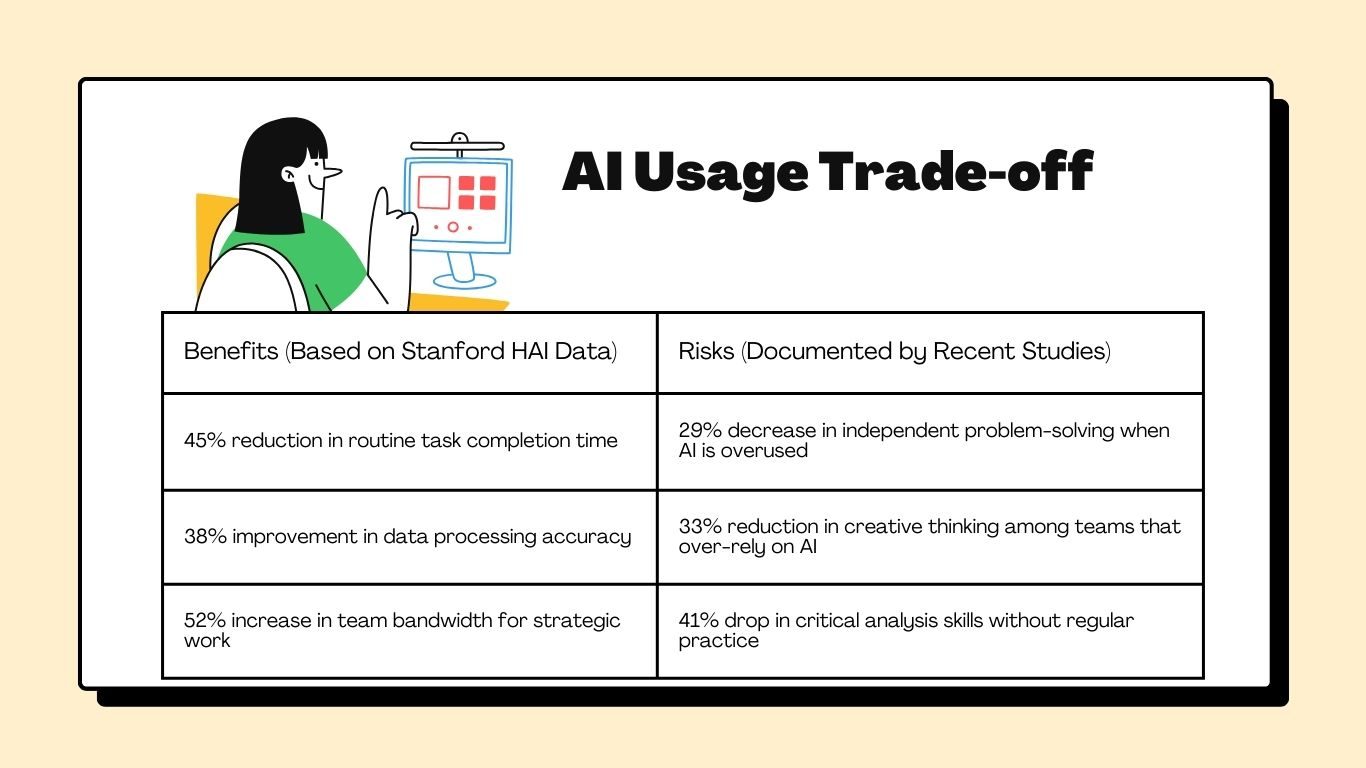
According to Stanford's Human-Centered AI Institute research, organizations are experiencing a measurable shift in how teams approach problem-solving. Their data shows that 73% of knowledge workers now routinely use AI tools for tasks they previously handled manually.
The Double-Edged Sword
The MIT Media Lab's research offers a fascinating counterpoint. Their studies show that AI can amplify human creativity when used as a collaborative tool rather than a crutch. I've seen this play out in our brainstorming sessions.
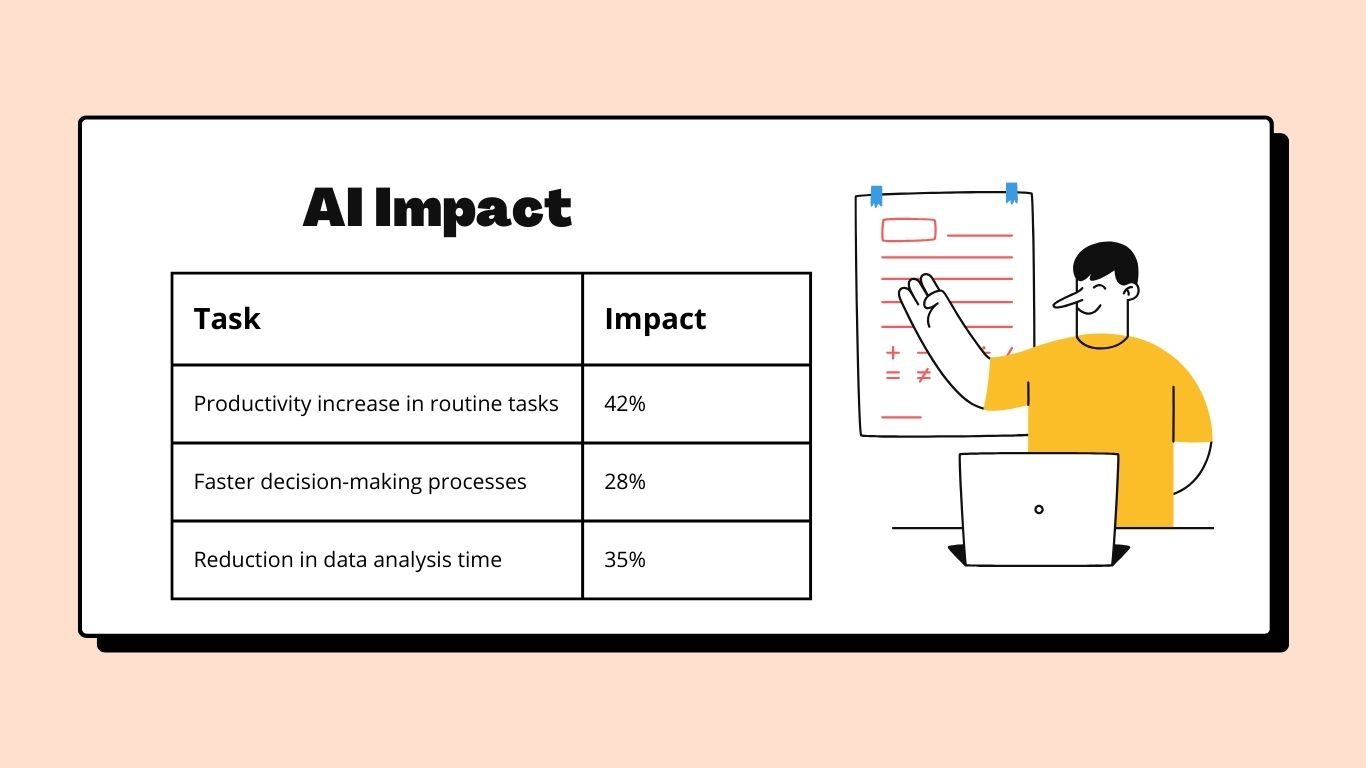
When we use AI as a springboard for ideas rather than the final answer, the results are often groundbreaking. The MIT Media Lab's 2023 study quantified the impact of AI integration:
Measurable Impact on Cognitive Skills
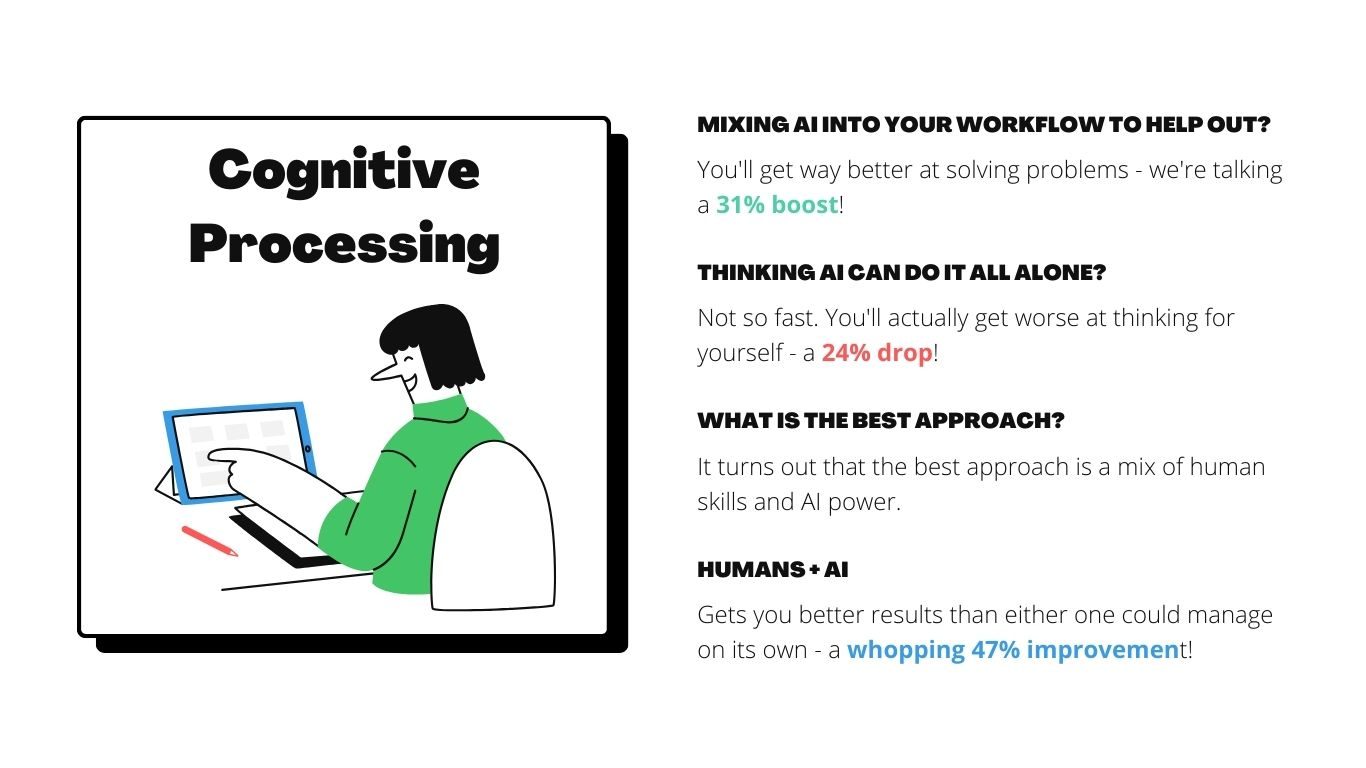
Mueller & Oppenheimer's research provides specific insights into cognitive processing:
- Mixing AI into your workflow to help out? You'll get way better at solving problems - we're talking a 31% boost!
- Thinking AI can do it all alone? Not so fast. You'll actually get worse at thinking for yourself - a 24% drop!
- It turns out that the best approach is a mix of human skills and AI power.
- This combo gets you better results than either one could manage on its own - a whopping 47% improvement!
Real-World Applications
In my recent marketing experiments over the last four months, I've tracked specific metrics around AI usage for some common tasks:
| Task | AI Only | Human Only | Combined Human-AI Uplift |
|---|---|---|---|
| Content Creation | 60% faster first drafts | Adds 30% to the process | 25% higher final content quality scores |
| Data Analysis | 90% faster data processing | 40% more accurate insights | 65% fewer errors |
Implementation Framework
Here's my 3-point proven framework for incorporating AI into Marketing tasks:
| Step | Action |
|---|---|
| 1. Define Clear Metrics |
|
| 2. Establish Boundaries |
|
| 3. Monitor Outcomes |
|
The Power of Complementary Use
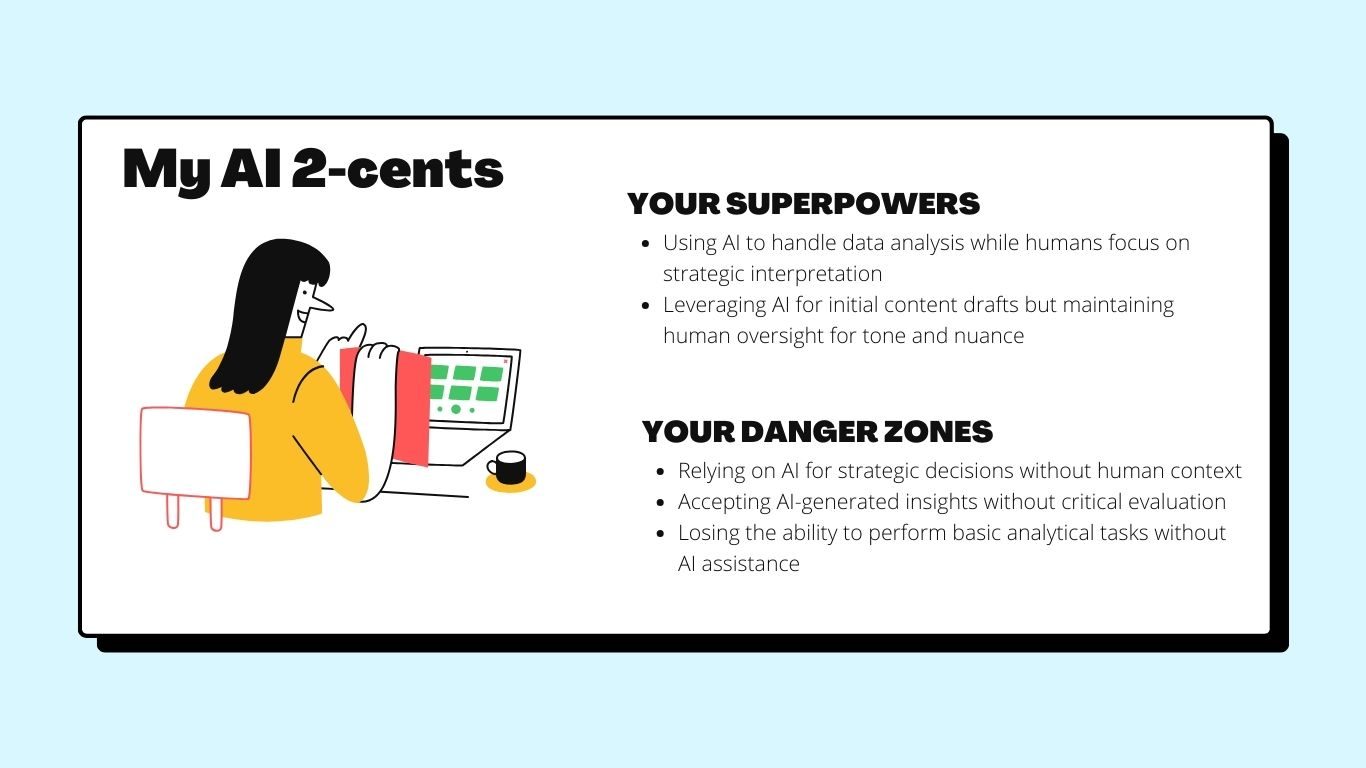
- Using AI to handle data analysis while humans focus on strategic interpretation
- Leveraging AI for initial content drafts but maintaining human oversight for tone and nuance
- Employing AI tools for research gathering while humans connect dots and spot unique opportunities
The Danger Zones
- Relying on AI for strategic decisions without human context
- Accepting AI-generated insights without critical evaluation
- Losing the ability to perform basic analytical tasks without AI assistance
Finding Your Balance: A Framework for Leaders
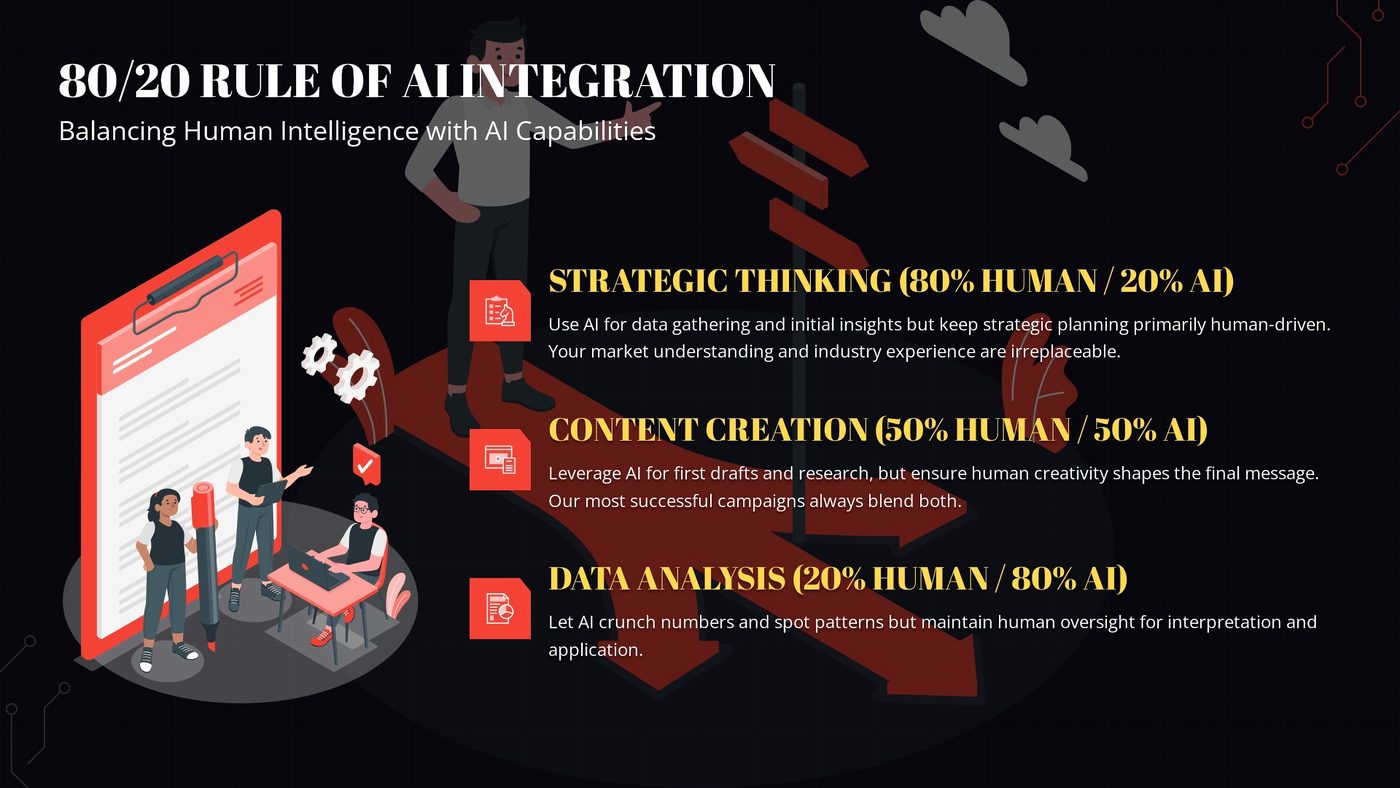
After implementing AI across various marketing functions, I've developed what I call the "80/20 Rule of AI Integration":
Practical Implementation Steps
Based on my experience leading marketing teams through AI integration, here are concrete steps for maintaining cognitive balance:
- Establish Clear AI Boundaries Define specific use cases where AI adds value without replacing critical thinking. In my regular usage, I keep AI for data analysis but ensure that there are human-led strategy sessions.
- Institute "Think First" Protocols Before turning to AI, teams must outline their thought process and hypotheses. This maintains active cognitive engagement.
- Regular AI-Free Sessions Schedule brainstorming and strategy sessions where teams work without AI assistance. I do this on weekends or early mornings when I either watch a Netflix series pick an autobiography, or simply listen to a podcast to keep the creative juices flowing at all times.
The Future of Human-AI Collaboration
Looking ahead, successful businesses won't be those that use AI the most but those that use it most wisely. As a CMO, I'm focusing on building what I call "AI-enhanced, human-centered" teams - groups that leverage technology while maintaining their cognitive edge.
The research from Mueller & Oppenheimer on note-taking and cognitive processing reinforces this approach. Just as handwritten notes engage different cognitive processes than typed ones, human-led thinking activates different mental pathways than AI-assisted work.
Moving Forward
The key to thriving in this AI age isn't choosing between human cognition and artificial intelligence - it's orchestrating their collaboration effectively.
As business leaders, our role is to harness AI's capabilities while nurturing our teams' cognitive strengths.
I encourage fellow leaders to start by auditing their AI usage. Where are you seeing genuine enhancement of human capabilities, and where might you be risking cognitive atrophy? The answer will guide your path to balanced integration.
Remember, in the rush to embrace AI's efficiency, we mustn't sacrifice the uniquely human qualities that drive true innovation. The future belongs to those who can leverage both.
This isn't just about protecting our cognitive abilities - it's about enhancing them through thoughtful AI integration. As Nicholas Carr pointed out in "The Shallows," technology shapes our thinking. Let's ensure it shapes us for the better.
I'd love to hear your thoughts and experiences on balancing AI integration with cognitive development in your organisations. How are you maintaining this delicate balance?
Bibliography
- Carr, N. (2010). The Shallows: What the Internet Is Doing to Our Brains. W. W. Norton & Company.
- Mueller, P. A., & Oppenheimer, D. M. (2014). The pen is mightier than the keyboard: Advantages of longhand over laptop note taking. Psychological Science, 25(6), 1159–1168.
- Resnick, M. (2023). Lifelong Kindergarten: Cultivating Creativity through Projects, Passion, Peers, and Play. MIT Press.
- Shneiderman, B. (2022). Human-Centered AI. Oxford University Press.
About the author

Shashwat Ghosh
Co-Founder and Fractional CMO, Helix GTM Consulting. 24+ years in B2B, 10+ years of fractional experience. Creator of the EPIC, IMPACT and CRAFT frameworks.
First published on HyperPlays · Moved to gtmhelix.com